
Everything between the story breaking and the post going live.
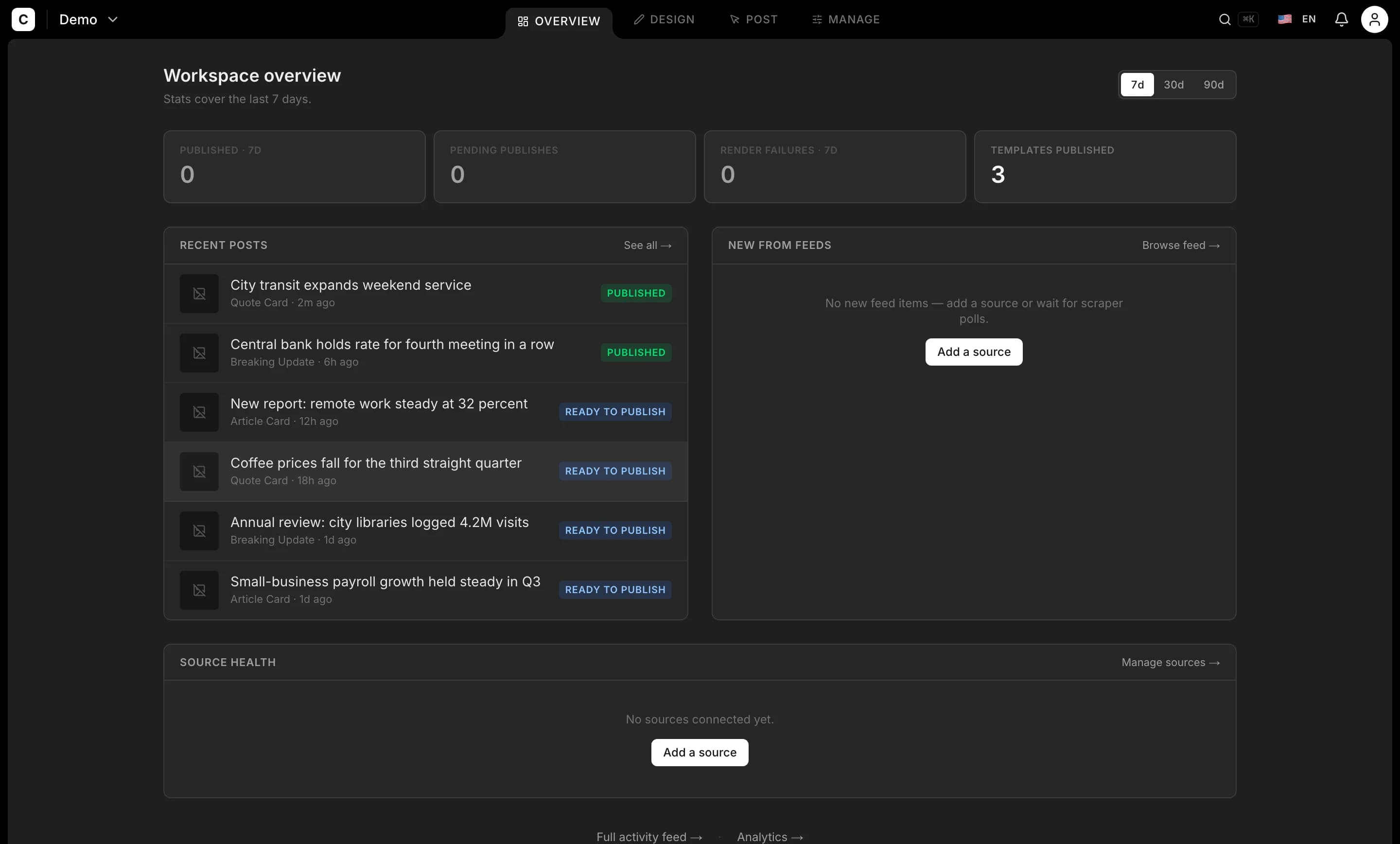
HyperContent watches your sources, clusters what’s moving, and drafts it in your own house voice. An editor approves every word. Then locked brand templates render each destination’s format and publish it — Instagram, Facebook, Threads, X, TikTok, and your CMS — from a single action.
7-day trial on Starter · card required, cancel any time before it ends · no setup call
- InstagramFeed · Story · Reel
- FacebookPage photo · Story
- ThreadsPost · Carousel
- XTweet · Thread
- TikTokVideo · Photo
Most social tools start at the caption. We start three steps earlier.
Scheduling is the last five minutes of the job. The hours are in finding the story, writing it, checking it, and getting it into shape for five different destinations. That whole stretch is the product.
- 01
Ingest
RSS, HTML scrapers, and monitored social accounts poll every minute.
- 02
Cluster
Items are grouped across sources into scored topics — what's actually moving.
- 03
Draft
Reporter writes in your house voice, grounded only in the source material.
- 04Human gate
Review
Every draft lands in review. An editor decides. Nothing skips this step.
- 05
Render
Locked templates render each destination's aspect ratio — stills and MP4.
- 06
Publish
Direct to each platform's API, paced per account, resumable on failure.
An AI journalist that files drafts, never posts.
Reporter reads what you tell it to read, works out what's worth covering, and hands an editor a draft with its sources attached. It has no publish button — that's the point.
Watches the sources you choose
RSS feeds, CSS-selector scrapers for sites without one, and monitored accounts on YouTube, Reddit, Instagram, TikTok, X and LinkedIn. Polled on your interval, deduplicated on arrival.
Clusters across sources, not within one
The same story from six outlets becomes one scored topic rather than six items. What's genuinely moving separates itself from what one wire service happened to publish twice.
Writes in your house voice
Style is distilled from your own published archive — and only from pieces your team wrote, never from previously generated ones, so the voice can't drift into a copy of a copy.
Grounded only in the source material
Facts come from the public feeds you configured. Reporter never sees your account data or anyone's personal information; that boundary is enforced in the architecture, not by prompt.
Checks itself before you check it
Claims are verified against live web search with a bias toward primary sources, and verdicts arrive with the links attached. SEO scoring proposes a slug, keywords and a meta description.
Runs on a standing assignment
Give Reporter a beat and a cadence and it drafts from the top-scoring topics on schedule. Everything it produces still lands in review, and an editor still decides.
More on how Reporter works — included on the Newsroom plan.
Where brand drift goes to die.
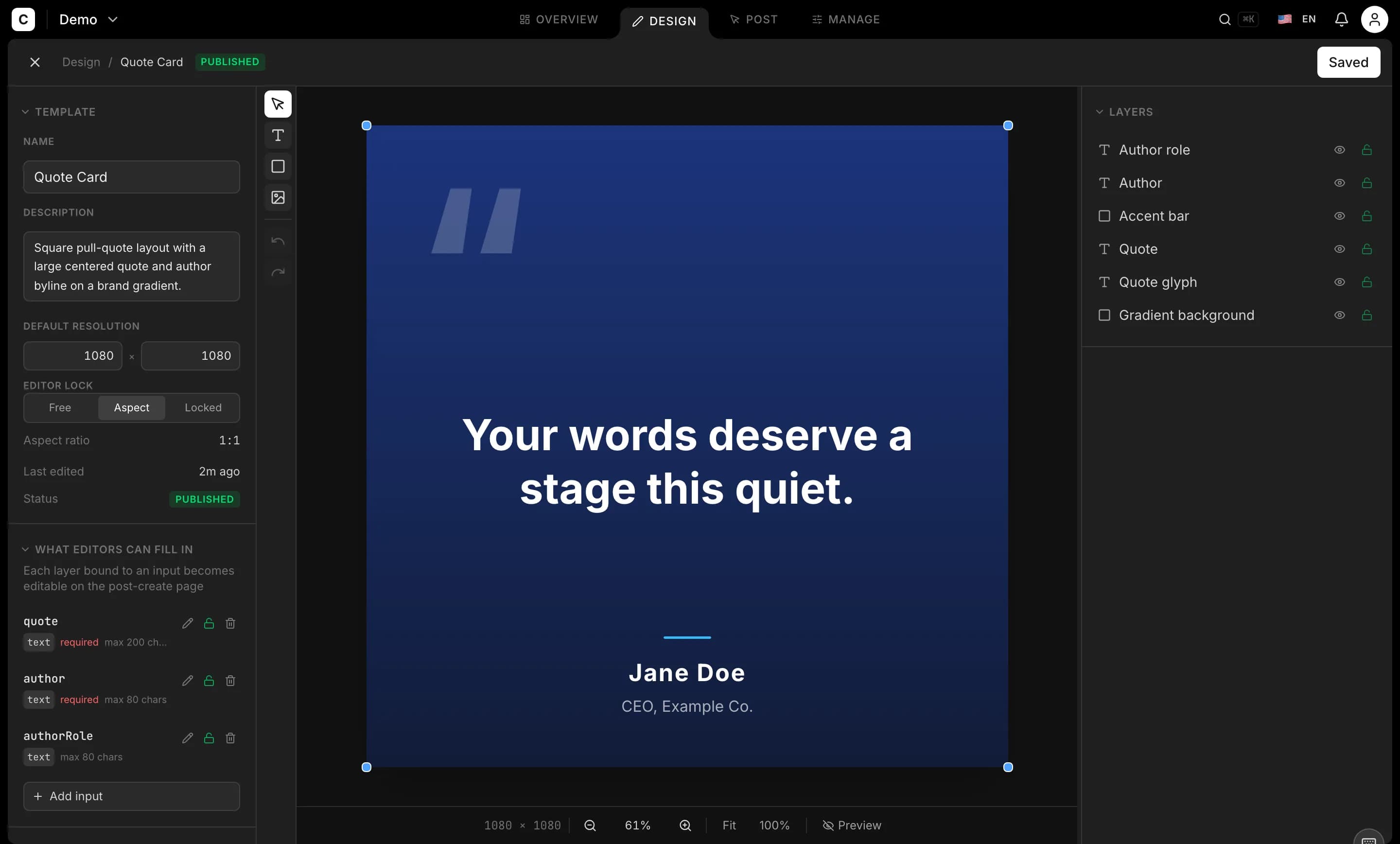
Designers lose hours to the same corrections: wrong weight, off brand-palette, a crop that cuts the logo. HyperContent moves that work upstream. The designer sets the constraints once, the editor fills in the content, and the output is on brand because it cannot be anything else.
- Brand colours, typography and layout grids locked at the layer level. Editors fill fields in; they can't redesign.
- Import a PSD or build in the browser canvas. Layers you nominate become editable inputs, everything else stays fixed.
- One template covers 1:1, 4:5 and 9:16 — per-layer anchors reflow the layout instead of cropping it.
- Layout can compute: a caption box can size itself from the headline above it, so long titles never collide.
- Video templates render to real MP4 server-side, not a slideshow of stills.
- Every template is frozen onto the post at the moment it's created. A designer's edit can never shift something already queued.
One post. Six destinations. No copy-paste.
A post in HyperContent is one canonical piece of writing plus the variants each platform needs. Change the canonical and the variants follow; change a variant and it stays changed.
- Write the post once. Each destination gets its own caption, alt text, hashtags and first comment — inherited by default, overridden where it matters.
- Native options are modelled properly, not flattened: TikTok privacy and duet settings, Threads reply control, X reply permissions, Instagram comment settings.
- Character ceilings are enforced after the link is appended, so an auto-added UTM can't silently push you past a platform's limit.
- Text-only destinations skip rendering entirely instead of waiting on an image they'll never use.
- UTM tags are applied per platform, and never overwrite parameters you set yourself.
- InstagramFeed4:578/2,200
The riverside plan cleared council last night, 31–12. What changes, and when →
- ThreadsPost4:557/500
Riverside plan passes 31–12. Here's what actually changes →
- XTweet16:950/280
Riverside plan passes council 31–12. What changes →
- TikTokPhoto1:162/2,200
Council said yes to the riverside plan. Swipe for the timeline.
The 6pm bulletin goes out at 6pm.
Scheduling is easy to demo and hard to do well. What matters is what happens when a platform rate-limits you, a token expires, or a worker dies mid-publish.
A crashed worker resumes, it doesn't retry blindly
Publishing runs as a durable workflow checkpointed in Postgres. If the process dies halfway through a five-destination fan-out, it picks up at the step it reached — no lost post, no duplicate.
Paced per account, not per queue
Each connected account has its own rate gate. A deferred job wakes exactly when that account's next slot opens, so one busy handle never delays another.
Knows the difference between throttled and out of quota
When a platform says you've spent your daily posting window, you're told that — rather than watching a job retry into a wall it can't clear until tomorrow.
Tokens refresh before they expire
A sweep runs every fifteen minutes. If a connection still needs human attention you get a notification naming the account, not a failed post at 6pm.
Reconnecting doesn't orphan your history
Disconnect and reconnect an account and its past posts stay attached to it. Analytics don't reset because someone re-authorised.
Failures are inspectable
Anything that ultimately can't publish lands somewhere you can read, with the platform's own error attached — not swallowed into a log nobody sees.
Including the posts you didn’t publish here.
Most tools can only report on what went through them, which makes their numbers useless the moment someone posts from their phone. HyperContent reads your connected profiles directly, so the account view is the account, not our slice of it.
- Likes, views, comments, shares, saves, reach and impressions, rolled up per post, per template and per source — so you can see which template earns its keep.
- Posts published outside HyperContent are swept in from your connected profiles, so the picture covers the whole account rather than only what we sent.
- Real comment text is ingested for Instagram, Facebook and Threads — not just a count.
- Predicted engagement is scored before publishing and charted against what actually happened, so you can see whether the prediction deserves your trust.
- Export any view to CSV when someone needs it in a spreadsheet.
Instagram, Facebook, Threads, X, TikTok and your CMS — eleven distinct post types, each through an official API.
English, Serbian, Polish, German, Spanish, French, Italian, Romanian, Bulgarian and Albanian.
A primary model and three fallbacks. If one provider degrades, drafting keeps working instead of stopping.
The per-workspace generation ceiling, sized deliberately for daily newsroom volume rather than occasional use.
Built to hold your brand's credentials.
You're handing a tool the keys to every account you publish from. Here's what protects them — the full detail is on the security page.
EU-hosted end to end
Application, worker, and database tiers all run in the same EU region. Your content doesn't leave it in normal operation.
Credentials encrypted at rest
Every connected-account token is sealed with AES-256-GCM and decrypted only at the moment of publishing or refresh.
Step-up verification by default
A sign-in from an unrecognised device needs an emailed code. Authenticator apps are supported as a stronger second factor.
Two separate audit trails
Workspace actions and account-security events are logged independently. IP addresses are stored as salted hashes, never raw.
Granular, deny-by-default roles
Admin, designer and editor ship as defaults, and you can define your own. A member with no role assigned can see nothing.
GDPR, with a DPA you can sign
Standard Contractual Clauses, a named sub-processor list, and a signable DPA on request within two business days.
Start on a trial. Move up when the volume says so.
Sign up and be publishing the same afternoon — no procurement, no discovery call. Upgrade, downgrade or cancel yourself, any time.
For a solo creator or a small desk finding its rhythm.
- 2 seats
- 5 connected accounts
- 25 templates
- 500 renders / month
- AI assistant included
For a team publishing across every platform, every day.
- 5 seats
- 15 connected accounts
- Unlimited templates
- 2,000 renders / month
- 50 feed sources
For a full newsroom running AI-assisted reporting at volume.
- 15 seats
- 50 connected accounts
- Unlimited templates & renders
- 200 feed sources
- Reporter — clustering & drafting
For multi-brand organisations with governance requirements.
- Unlimited seats across workspaces
- Custom platform connectors
- Dedicated onboarding
- Annual invoicing
Compare every plan side by side — including annual pricing, storage and AI budgets.
Common questions.
What can we publish to, exactly?+
Direct API publishing to Instagram (feed, story, reel), Facebook Pages (photo and story), Threads (single posts and carousels), X (single tweets and threads), and TikTok (video and photo) — eleven post types across five networks. Articles publish straight to WordPress, Ghost or Strapi from the article editor, and a webhook destination covers anything custom. There's also a hosted article page you can use with no CMS at all.
What is Reporter?+
Reporter is the story-discovery and drafting layer. Connect RSS feeds, web scrapers and monitored social accounts, and it clusters incoming items across sources into scored topics organised by your content categories. Pick one and a draft generates from the source material in your own house voice, landing in review for an editor. It can also work from a standing assignment — a beat and a cadence — and draft on schedule. Reporter is included on the Newsroom plan.
Does it publish anything on its own?+
No. Every generated article arrives with a status of 'review' and waits for a person. There is no auto-publish path from Reporter to a live post, by design — the tool writes and revises, the journalist verifies and decides.
Does HyperContent include an article editor?+
Yes. The built-in editor supports full-length writing with AI assistance — rewrite, shorten, change the lede, or shift the focus of any piece. Fact-checking runs against live web search with a bias toward primary sources and returns verdicts with links. SEO analysis scores the article and proposes keywords, a URL slug and a meta description before you publish. You can also start from a URL, a YouTube video, or an uploaded audio or video file, which gets transcribed.
Do we need separate templates per aspect ratio?+
No. One template declares the aspects it supports (1:1, 4:5, 9:16) and per-layer anchors reflow the layout between them rather than cropping. Designers author once and the correct resolution renders for each destination automatically. Video templates render to real MP4 server-side.
Can our designers keep using Photoshop?+
Yes. PSDs import into the canvas editor with layers preserved. Designers nominate which layers become editor-fillable inputs; everything else stays locked. Fonts and images can also be uploaded to the shared asset library and used across every template in the workspace.
We run several accounts on the same network. Can they be configured separately?+
Yes. Settings live per connected account and survive token refreshes, so each handle can have its own default hashtags, reply-control rules, caption templates and first-comment text.
How are roles and permissions handled?+
Three roles ship by default — admin, designer and editor — and you can define your own with granular permissions across templates, posts, articles, analytics, workspace settings and membership. A member with no role assigned has no permissions at all; there's no implicit read-everything tier. SAML/OIDC single sign-on is not available yet and is on the roadmap for Enterprise.
Where is our data held?+
In the EU. The application, worker and database tiers all run in the same EU region, connected-account tokens are encrypted at rest with AES-256-GCM, and a signable DPA incorporating the Standard Contractual Clauses is available on request.
How do we get started?+
Sign up, create a workspace and start a 7-day free trial on Starter. A card is required up front and you can cancel any time before the trial ends. Connect your accounts and publish straight away, then move to Growth or Newsroom as the volume grows. Larger organisations with multi-brand or governance requirements can contact us about Enterprise.
Publish your first branded post today.
Create a workspace, connect an account, pick a template. The trial gives you seven days to decide whether this replaces the four tools you’re currently taping together.
Card required · cancel any time before day seven · EU-hosted